© 2017-2026 Shangbaotai Machine Technology (Kunshan) Co., Ltd. All rights reserved. Site Map

A new cutter can produce the specified nominal width while the noodle still fails its thickness or shape requirement. The incoming sheet may vary across its width, spring back after rolling, or stretch between the final rolls and the cutter. Replacing the slitter alone will not correct an unstable sheet.
For sheeted flour-based noodles, select the noodle rolling machine, reduction section, and slitter as a matched process. Start with the product dimensions and accepted output, then establish the sheet condition and tooling required to achieve them. Extruded noodles follow a different forming route and need a separate equipment review.
Specify the target noodle using a drawing or approved sample. Record thickness, width or diameter, cross-section, length, and whether the strand is straight or wavy. Give tolerances and identify when dimensions are measured: immediately after cutting, after resting, after steaming or drying, or after cooking. Those measurements cannot be treated as interchangeable.
| Product requirement | Main equipment or process relationship | What to confirm in the trial |
|---|---|---|
| Noodle thickness | Reduction-roll settings, actual sheet response, and transfer to the slitter | Thickness across the sheet and after cutting at a defined measurement time |
| Strand width | Cutter pitch or geometry, cutting condition, and sheet stability | Actual strand width and separation, including edge strands |
| Cross-section | Cutter profile matched to the incoming sheet thickness and dough | Approved rectangular, square, rounded, or other specified section |
| Wave pattern | Slitting, receiving conveyor, and any wave-forming mechanism | Wave pitch, height, uniformity, and behavior at the required output |
| Strand length | Downstream cut-off and product transport | Cut length, portion consistency, and transfer without stretching or piling |
For a square section, the approved strand width and thickness must be coordinated. A square-profile cutter does not independently set both dimensions. A rounded profile also requires the correct sheet and tooling combination; approve the actual section instead of relying on the tool's name.
Compounding combines rough sheets into a band for further processing in a sheeted-noodle route. Ask the supplier to show the complete process: incoming dough or sheets, compounding arrangement, any resting or conveying, progressive reduction, and final cutting. The compound unit and the complete reduction train are different procurement boundaries.
Shangbaotai lists a compound roller, but its public page does not establish a project-specific stage count, roller diameter, final-thickness range, or accepted output. Request those details in a configuration drawing and stage schedule. Do not assume that purchasing the compound unit includes every stand needed before cutting.
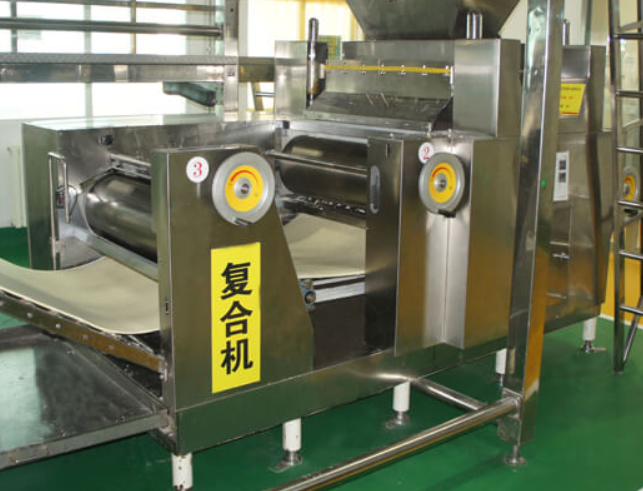
Official Shangbaotai compound roller product image. The complete rolling and cutting scope must be defined in the project proposal.
Distinguish nominal roller width, usable sheet width, cutter working width, and the width available on the receiving conveyor. Allow for tracking and any planned edge trim. A wider upstream roller provides no useful capacity advantage if the slitter or next process cannot accept the resulting sheet.
Shangbaotai's noodle slitter machine page publishes a width reference of 200–1000 mm and square, round, or requested tooth forms. This equipment-width reference does not state the width of individual strands or guarantee the range for a specific quoted cutter. Ask for the usable cutting width, strand dimensions, profile drawing, and approved tooling combinations.
For each SKU, specify the planned sheet width at the final reduction rolls and at the cutter. Ask how the sheet is centered, how edge material is handled, and what happens during tracking drift. Confirm that scrapers, guides, and cutter accessories are designed for the same working width.
Request a stage-by-stage schedule showing measured incoming and outgoing sheet thickness, nominal roll gap, roller diameter, sheet speed, and drive arrangement. The required number of stages depends on the starting sheet, recipe, process history, target thickness, and demonstrated product quality.
Define the terminology used for the reduction ratio. For this specification, percentage thickness reduction per pass means:
Thickness reduction (%) = (incoming thickness − outgoing thickness) ÷ incoming thickness × 100.
A change from 3.0 mm to 2.4 mm is a 20% thickness reduction; it retains 80% of the starting thickness. This is an arithmetic example, not a recommended setting. Some suppliers use “reduction ratio” for a different thickness relationship, so require the formula and the measurement points in the proposal.
Do not set every stage to one percentage copied from another product. Test the reduction schedule with the intended flour, water addition, dough temperature, and resting conditions. A supplier should demonstrate the required result without persistent tears, excessive sticking, or unstable sheet dimensions, then document the approved settings.
Dough can recover after leaving the rolls, so nominal gap and actual thickness can differ. Measure both. Use a defined method with controlled contact force and timing so the measurement itself does not compress the sample inconsistently.
Sample the left, center, and right of the usable sheet and repeat the checks during the run. Agree on the allowed variation and how measurements are recorded. If thickness varies across the width, ask the supplier to review roll alignment, loaded behavior, feed distribution, and gap adjustment before changing the cutter.
Confirm how the final settings are reproduced after cleaning and changeover. A display or scale can help operators return to a setting, but the acceptance measure remains the actual sheet and strand. An automatic thickness-control function, if required, should be identified explicitly rather than inferred from an adjustable roller gap.
Provide the incoming sheet-thickness range and condition alongside the desired strand profile. Ask for cutter pitch or groove geometry, working width, drive connection, mating parts, scraper or comb arrangement, cleaning access, and wear checks. A replacement knife roll must fit mechanically and functionally with the existing assembly.
For flat rectangular strands, the rolling section establishes sheet thickness while the cutter principally establishes lateral width. Profiled cutters require a coordinated sheet and cutter geometry. Use samples to verify the section, edge finish, sticking, joined strands, and breakage. Document which tools produce each launch SKU.
Confirm how the supplier specifies cutter size. A cutter number without a dimensioned profile can be ambiguous across suppliers. Ask for actual millimeter dimensions and tolerances, together with the method used to inspect the product.
For wavy noodles, request a drawing of the forming and receiving arrangement after slitting. The slitter page refers to wave generation, but does not define a complete wave-forming configuration. Verify the supplied mechanism and its interaction with product discharge; do not assume changing the cutter alone controls the wave pattern.
Thinning changes the sheet flow requirement. As a simplified continuity check, if width and density stay constant and material losses are ignored, reducing thickness from 2.0 mm to 1.6 mm requires the outgoing sheet speed to be 1.25 times the incoming sheet speed. This is a material-flow calculation, not a roller-RPM command or drive setting; slip, width changes, and dough response require a tested control arrangement.
Ask how adjacent stands and the slitter are coordinated. Excessive pull can stretch the sheet, while overfeeding can create folds or accumulation. Include startup, speed changes, and downstream stops in the trial. Identify the sensing and control functions actually supplied, plus how partly processed material is handled during restart.
Keep dough conditions within the trial specification. Uneven hydration, temperature changes, resting time, surface drying, and dusting can change sheet handling and cutting behavior. Record them when evaluating a new noodle specification. Otherwise, equipment adjustments may be used to chase a recipe or feed variation that remains unresolved.
Use the noodle-making equipment range to identify the relevant modules, then request one proposal covering the complete rolling-to-cutting boundary. Separate equipment capabilities confirmed by tests from future tooling options.
| RFQ field | Buyer input | Supplier response |
|---|---|---|
| Product | Samples, dimensioned section, tolerances, straight or wavy form, and measurement stage | Approved profiles, cutter set, and product acceptance method |
| Dough | Flour and formula information, hydration basis, temperature, resting, and feed presentation | Trial conditions, incoming-sheet limits, and any required upstream changes |
| Rolling | Starting and final sheet requirements, usable width, and accepted output | Compounding scope, reduction stands, gaps, speeds, adjustment, and measurement |
| Cutting | Strand dimensions, profile, working width, and changeover needs | Tool drawings, mating components, scrapers, drive interface, and wear criteria |
| Line interfaces | Existing machines, conveyor heights, direction, downstream demand, and site utilities | Layout, supplied controls, handoff ownership, and stop-and-restart sequence |
| Acceptance | Output basis, quality limits, trial duration, and sampling plan | Test procedure, recorded results, exclusions, and correction or retest conditions |
When comparing a compound roller noodle machine with a separate rolling-and-cutting proposal, align the scope first. Include conveyors, reduction stands, cutter tools, guards, change parts, and controls where required. Confirm cleaning and maintenance access and which removal tasks require special lifting or handling equipment.
Run the intended recipes and tools for an agreed period. Record actual sheet thickness across the width, strand width and section, edge condition, separation, trim, breakage, and accepted wet output. State whether capacity is measured before or after trim and rejects; final dried or cooked kilograms need a separate agreed basis.
Include the thinnest, widest, or most difficult launch specification, not only the easiest product. Test changeover and return to stable output. If the target dimensions apply after steaming, drying, or cooking, carry representative samples through that process before approving the product specification.
It describes the published equipment-width range. Individual strand width and profile need a separate cutter specification and product trial.
First check the sheet entering the cutter. The reduction section, dough recovery, and transfer conditions must provide the required thickness consistently before the cutter's performance can be judged.
Request a tested schedule for the starting sheet, recipe, and final specification. The public compound roller page does not establish one stage count or reduction percentage for every application.
The cutter and actual sheet thickness must produce the approved width-to-thickness relationship. Verify the cross-section at the agreed measurement stage.
Provide noodle samples or drawings, formula and dough conditions, target dimensions and tolerances, accepted output, current roller and cutter information, and the line layout.
Submit the product and interface schedule through Shangbaotai's inquiry page. Ask for a complete compounding and reduction arrangement, a matched cutter drawing, stage-by-stage settings, and a sample-test plan. Approve the system against measured sheet and strand results at the required line output.