© 2017-2026 Shangbaotai Machine Technology (Kunshan) Co., Ltd. All rights reserved. Site Map

A beverage factory can buy a faster capper and still lose output if caps feed poorly, filled bottles rotate during closing, or the next conveyor blocks discharge. A new bottle shape can also expose problems that were invisible with the original format. Equipment selection starts with the bottle and closure combination, then checks how it will run through the installed line.
This guide helps packaging engineers and procurement managers prepare a bottle capping machine specification. It uses Shangbaotai's published PET-bottle equipment as the supplier reference while separating general closure-selection principles from capabilities that require sample trials and a technical proposal.
Send the bottle-neck drawing, cap drawing, and production samples as a matched set. Record the thread or seating geometry, liner if present, tamper feature, cap dimensions, and the required closing result. Similar cap diameters do not establish that two closures can use the same head or feeding system.
Shangbaotai's beverage packaging equipment range lists two capping products using “Crown Capping” in their English names. Their specifications identify PET bottles, but do not clearly establish the closure construction or torque-control method. Ask the supplier to identify the actual cap type, capping action, and compatible neck finish for the proposed machine. Do not infer metal crown crimping or threaded screw capping from a product title alone.
| Closure supplied by the buyer | Closing requirement | What to ask the equipment supplier |
|---|---|---|
| Threaded screw cap | Correct thread engagement, specified tightening result, liner or seal performance, and acceptable opening behavior | How is the cap started, tightened, and checked? What torque-control and bottle-holding method is supplied? |
| Press-on closure | Correct seating position and engagement without damaging the bottle or cap | What force, travel, support, and seating checks are required? |
| Crimped crown closure | Approved crimp geometry and seal on the matching bottle finish | Is the proposed equipment designed for this closure and neck finish? What forming tools and acceptance checks are supplied? |
This is a closure-decision table, not a list of confirmed Shangbaotai applications. Select the relevant route with the supplier using the actual bottle and cap. For screw caps, ask it to explain whether a chuck, spindle, or another mechanism is proposed; for other closures, request the appropriate forming or seating method.
Provide bottle material, height, body dimensions, base shape, neck location, filled weight, and dimensional tolerances. Include round, rectangular, or other shapes in the SKU schedule. State whether the neck is centered and identify label or decorated surfaces that must not be scuffed.
Thin-walled bottles can deform under holding pressure; unstable shapes may tip during spacing or transfer. Glass requires protection against concentrated loads and impacts. The supplier should identify where each bottle is located and supported while the closing action is applied. A material name alone does not determine the correct handling system.
Send filled or otherwise representative bottles for trials, together with empty samples where useful. Include product temperature, fill level, and any neck contamination expected at the handoff from filling. Ask for handling tests with the smallest, largest, and least stable launch SKU. Both PET listings need project confirmation before they are extended to another bottle material or geometry.
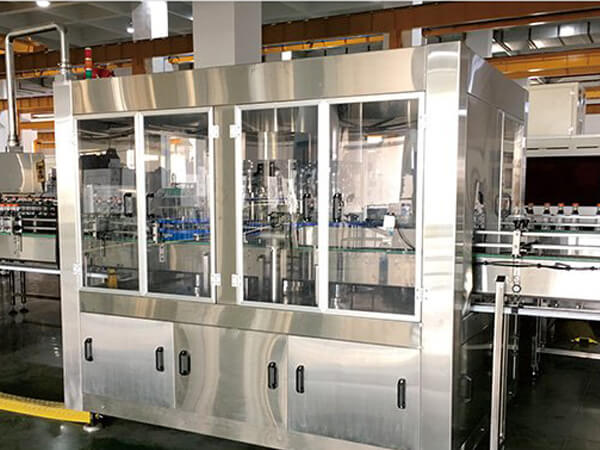
Shangbaotai's rotary PET bottle capping equipment page publishes up to 550 bottles per minute and 33,000 pieces per hour. Those figures are arithmetically consistent. The page also describes selectable cap-feeding arrangements and detection of missing, high, or tilted caps. Treat these as published references, then confirm the exact bottle, cap, supplied functions, and test basis.

Official product image from Shangbaotai's rotary PET bottle capping page. Verify closure compatibility and the supplied line arrangement in the technical proposal.
The separate customized high-speed bottle capping equipment page states up to 550 bottles per minute, while its parameter table lists 27,000 pieces per hour, equivalent to 450 per minute. Ask the supplier to reconcile the two figures and issue a current model-specific specification. Neither number should become a contractual output requirement without an agreed application and trial.
For either proposal, request a confirmed closure range, bottle-size range, head or closing mechanism, speed basis, cap feeder, inspection scope, change parts, and utilities. The equipment photograph and product name do not replace those details.
For screw caps, obtain the recommended application requirements from the bottle and closure suppliers. Include cap and neck construction, liner, tamper feature, and any agreed torque range. Applying more torque is not a reliable solution to every leak: poor thread engagement, a damaged liner, or bottle deformation requires a different correction.
Distinguish the machine's tightening setting from the measured torque needed to remove the cap. They are different measurements. Agree on the test instrument, units, sampling method, elapsed time after capping, product temperature, and pass limits. Opening torque can change with package condition and time, so a test without a defined procedure is difficult to compare.
Ask whether the machine controls a setting, measures a value, or records a result for each bottle. A servo drive alone does not prove closed-loop torque measurement. The proposal should name the supplied control method and show how it is verified with the actual pack.
For press-on or crimped closures, replace screw-cap torque criteria with the relevant seating or forming requirements. Specify closure position, engagement, package damage, and seal-performance tests. Keep any separate liner sealing operation in its own equipment scope rather than assuming it is included with capping.
Provide both incoming filled bottles per minute and required correctly closed, accepted bottles per minute for each SKU. State operating hours, replenishment, expected changes between formats, and the test duration. Clarify whether a quotation gives maximum motion speed, steady production, or output including routine stops.
For example, a requirement of 18,000 accepted bottles over 300 scheduled minutes is an average of 60 bottles per minute. If that period includes changeovers and planned interruptions, the required running rate must be assessed separately. This calculation defines demand; it does not identify a suitable machine or justify an arbitrary speed allowance.
A high speed bottle capping machine must have matching cap supply, bottle positioning, closing time, inspection, and discharge. Ask for demonstrated output with the least favorable launch bottle-and-cap combination. Agree on an operating allowance using measured stops and replenishment needs, rather than sizing every station exactly at a catalog maximum.
Specify how caps arrive: loose in bags or cartons, another bulk presentation, or already oriented. Give diameter, height, external features, weight, and the surfaces that may be contacted. Caps with similar dimensions can behave differently in a sorter or chute.
Ask how the feeder rejects incorrect orientation, transfers caps to the application point, and responds to a shortage or blockage. Include hopper capacity, replenishment access, required air or other services, and permitted cap damage. Define whether the quote includes an elevator, sorter, chute, placement mechanism, and connecting controls.
Trial the feeder through low supply, replenishment, startup, and the proposed running speed. A short closing demonstration with caps placed by hand does not verify an automatic bottle capping machine's complete output.
Submit a plan of filling, capping, inspection, labeling, and downstream packaging. Mark available space, conveyor height and width, flow direction, bottle spacing, transfer gaps, and accumulation. Include maintenance access and the route used to install or remove equipment.
For an existing line, show how bottles are held and spaced today. Ask which conveyors, guides, transfer parts, timing devices, and control connections must change. The supplier should explain how its proposed machine responds to no bottle, no cap, blocked discharge, and restart after a stop.
Replacing a bottleneck requires measured evidence. If the current capper stops because of poor cap orientation or unstable bottles, a faster closing mechanism alone may not address the cause. Record stops by cause, the SKU involved, and lost accepted output, then compare repair, feeding changes, and replacement against that evidence.
| RFQ field | Information to submit | Supplier response required |
|---|---|---|
| Bottle | Material, drawing, dimensions, neck finish, filled weight, temperature, tolerances, and samples | Approved handling range, support points, guides, and format parts |
| Cap | Closure type, dimensions, liner, tamper feature, bulk presentation, and samples | Confirmed closing route, feeding method, head or tooling, and exclusions |
| Quality | Torque or seating requirements, package tests, damage limits, and defect list | Control method, inspection functions, reject handling, and agreed test procedure |
| Speed | Incoming rate, accepted bottles/min by SKU, schedule, replenishment, and changeovers | Demonstrated output, operating conditions, bottleneck, and test duration |
| Layout | Conveyor details, upstream and downstream equipment, available space, and utilities | Installation drawing, interface ownership, utility loads, and stop logic |
| Changeover | Launch SKUs, future formats, run lengths, and required transition frequency | Change-parts list, adjustments, setup references, and trial plan |
Agree on a trial using representative bottles, caps, and filled conditions. Check feeding, bottle stability, closing quality, accepted output, stop-and-restart behavior, and changeover. Test every launch combination and repeat the agreed quality checks after changing formats.
List the defects the supplied system must detect and reject. Missing or tilted caps, for example, are different from inadequate torque or leakage. Ask the supplier to distinguish online checks from offline sample testing, and challenge the supplied detection functions with agreed defect samples. Verify that rejected bottles cannot rejoin accepted output.
The commercial comparison should cover the same boundary: capper, feeder, bottle handling, conveyors, controls, inspection, change parts, installation, documentation, and trials. Request exclusions and unresolved compatibility items in writing.
No. The listings identify PET bottles but do not clearly define closure construction. Send the neck and cap samples and request written confirmation of the actual closing mechanism.
It may, within a confirmed application range. Ask for a bottle-and-cap compatibility matrix, change parts, setup procedures, and trial results for every launch SKU.
Use requirements developed with the bottle and closure suppliers, then validate them on the actual pack. Record the measurement procedure and distinguish application requirements from removal-torque acceptance.
Request a reconciled, current specification for the quoted model and SKU. Use the agreed accepted-output trial as the purchase basis instead of selecting either conflicting figure without evidence.
Confirm the test method, supplied hardware, detectable defects, and reject logic. A reference to leak detection does not define sensitivity or prove that every closure defect is checked online.
Send bottle and cap samples, drawings, closure-quality requirements, accepted-output targets, and the existing layout through Shangbaotai's inquiry page. Ask for a confirmed cap type and mechanism, reconciled speed rating, feeding arrangement, control and inspection scope, changeover plan, and sample-test procedure. Those answers turn a general equipment inquiry into a proposal that can be evaluated against the factory's production requirement.