© 2017-2026 Shangbaotai Machine Technology (Kunshan) Co., Ltd. All rights reserved. Site Map

Two suppliers may quote a “complete” instant noodle factory but stop at different points. One proposal may end with cooled noodle cakes; another may include seasoning, packing, inspection and cartoning. A useful RFQ must define the first and last supplied machines, every interface, and all buyer-supplied systems.
A commercial instant noodle production line starts before the mixer and continues beyond the fryer. Use the following scope map to compare quotations.
| Process stage | Equipment or function to define | Key RFQ question |
|---|---|---|
| Ingredient handling | Flour receiving, sieving, conveying, weighing, brine tanks and liquid dosing | Where does supplier responsibility begin? |
| Dough preparation | Mixing, discharge, resting, breaking and controlled feeding | Is capacity based on flour or total dough? |
| Sheet forming | Compound rolling, reduction stands, slitting and wave forming | Which widths, cutter sets and change parts are included? |
| Cooking and forming | Steaming, seasoning, cutting, folding and cake retainers | Which product and cake specification support the stated output? |
| Dehydration | Fryer with oil management, or a confirmed non-fried drying system | What process route, utilities and safety systems apply? |
| Cooling and transfer | Cooling, accumulation and controlled delivery to packing | What happens when the packer stops? |
| Packaging | Seasoning insertion, primary pack, inspection, cartoning and pallet handling | Which operations are included and who integrates them? |

Horizontal mixing equipment for the dough-preparation section.
A machine list alone is not enough. The same name can describe different working widths, controls, materials, residence times and access provisions. For mixers, state working batch, cycle, liquid dosing, discharge and cleaning. For rolling, state width, thickness range, reduction arrangement, drive control and guarding. For slitters, list every cutter set and strand specification.
Shangbaotai’s noodle-making equipment range includes flour supply, continuous and horizontal mixers, dough conveyors, compound rollers, slitters, steam boxes, fryers, filters and coolers. The actual model and project scope still need a written technical schedule.

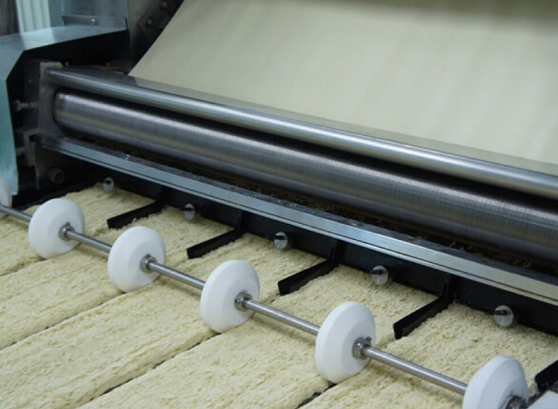
Compound rolling is one of the interfaces that must match working width and downstream capacity.
Bag, cup, bowl and carton formats require different equipment. Send package drawings, film or container specifications, seasoning-sachet details, code requirements and case patterns with the RFQ. Ask for demonstrated speed using the intended product and material.
Shangbaotai lists several noodle packaging machines. Confirm whether product feeding, sachet insertion, sealing, coding, inspection, rejects and cartoning are included. If another vendor supplies the packer, assign ownership for heights, signals, accumulation, guarding and final line testing.

Downstream packing must be sized and tested with the actual noodle product.
The machinery price may exclude the boiler, transformer, air compressor, water treatment, ventilation, drainage, wastewater handling, fire systems, platforms and civil work. Ask for a utility schedule and connection-point drawing. Mark whether the supplier stops at the machine terminal or also provides central plant systems.
Provide voltage, frequency, steam conditions, water and compressed-air data.
Send building dimensions, columns, clear height, doors, drains and floor limits.
Show raw-material, people, product, waste and maintenance routes.
Confirm local hygiene, environmental and fire requirements with qualified local parties.
For every system, record who owns design, manufacture, delivery, unloading, installation, utilities, software, testing, training, documentation and validation. Add export packing, freight, cranes, foundations, visas, local labor, trial materials and waste disposal. These items explain many apparent price differences.
Capacity should mean accepted output for a named recipe, cake weight, pack and test period. The acceptance plan can cover output, cake dimensions, moisture, breakage, cooking response, pack integrity, safety functions, alarms, changeovers and cleaning access. Agree on sampling methods and the treatment of open items before FAT.
Calling a line complete without defining its endpoints.
Comparing outputs based on different products or cake weights.
Omitting seasoning, inspection, cartoning or pallet handling.
Assuming utilities, civil work and installation are included.
Leaving third-party integration and stop logic unassigned.
Accepting “manuals” without a document list and delivery dates.
No universal boundary applies. Packaging is included only when the commercial proposal lists the machines, interfaces and performance basis.
This is project-specific. The line supplier should state utility requirements; the contract must identify who supplies and connects each central system.
Define accepted packs or mass per time period for a named product, quality specification, utility condition, staffing basis and test method.
Include assembly checks, safety functions, a dry run, product testing where practical, alarms, documents, output and quality measurements, and punch-list handling.
Send product and package specifications, required output, fried or confirmed non-fried route, site drawing, utilities, automation preference and target schedule. Ask each bidder to return the same responsibility matrix with deviations clearly marked.
Contact Shangbaotai with this information to discuss a project-specific factory scope.
